
How to Use Animated Commercials for B2B Lead Generation
Table of Contents
Animation is useful. But it needs a job.
Animated commercials can be a brilliant way to explain an idea, simplify a message or make a business feel more memorable.
They can take something complicated and make it easier to understand. They can help people quickly see the value of a product, service or process. They can also give a brand a visual style that feels different from everyone else in the market.
But animation on its own is not a lead generation strategy.
That is where many businesses go wrong.
They create a polished video, publish it once, maybe share it on LinkedIn, then wonder why it has not generated any real enquiries.
The problem is not always the video.
The problem is that the video has not been built into a wider system.
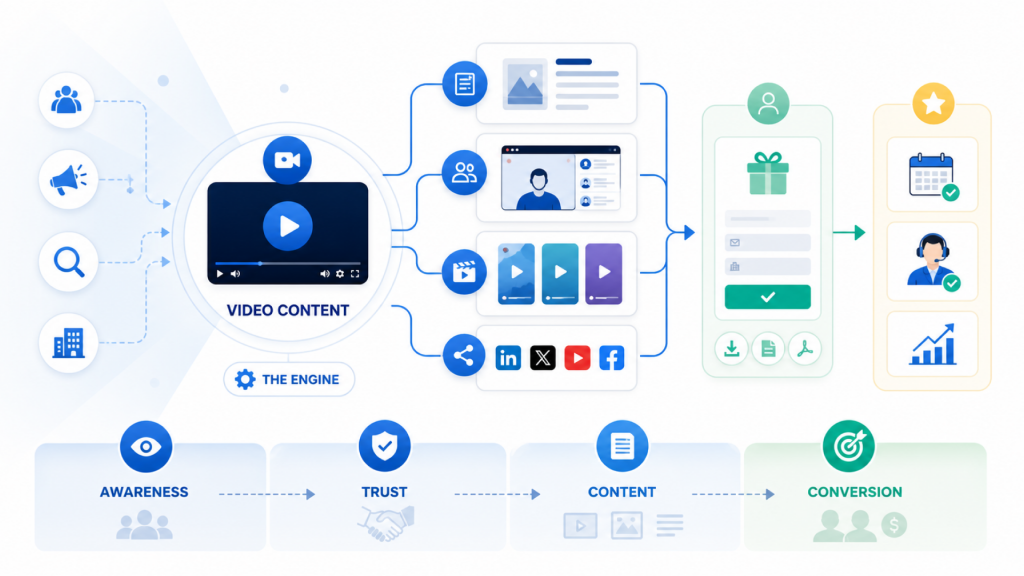
At Echo Works, our focus is on helping B2B companies create lead generation systems using podcasts, webinars, video and content.
Animation can still have a role in that system.
But it needs to support a commercial outcome.
Wistia’s video marketing research shows that businesses continue to invest in video promotion and distribution, which reinforces the point that video should be planned as part of a wider marketing system, not treated as a one-off asset.
What is an animated commercial?
An animated commercial is a video that uses illustration, motion graphics, character animation or visual storytelling to promote a product, service or idea.
It might be a short advert.
It might be an explainer video.
It might be a campaign asset for LinkedIn, YouTube or a landing page.
It might be used as part of a webinar, sales sequence or email nurture campaign.
The format is flexible.
That is one of the reasons animation has been so popular with businesses. It gives you control over the message, style, pacing and visual world.
You do not need locations, actors or physical sets.
You can show abstract ideas.
You can visualise data, processes, customer journeys or problems that are difficult to film.
For B2B companies, that can be extremely useful, especially if what you sell is complex, technical or difficult to explain in a few sentences.
The real question is not “should we use animation?”
A better question is:
What role should this video play in our lead generation system?
Because different videos do different jobs.
Some videos are designed to grab attention.
Some are designed to educate.
Some are designed to help someone understand a product.
Some are designed to build trust before a sales conversation.
Some are designed to support retargeting, email follow-up or sales enablement.
If you do not know what job the video has, it becomes very hard to measure whether it has worked.
That is why we now look at animated commercials as part of a wider conversion-focused content system, not as a standalone creative asset.
Where animated commercials can support lead generation
Animation works best when it helps move someone from confusion to clarity.
That can happen at different points in the buyer journey.
1. Explaining what you do
Some businesses struggle because their offer is not instantly clear.
This is especially common with:
- Technical services
- SaaS products
- Consultancy offers
- B2B platforms
- Training solutions
- Complex service packages
If someone lands on your website and does not understand what you do within a few seconds, they are unlikely to enquire.
An animated explainer can help simplify the message.
But it needs to sit in the right place.
For example, it might work well on:
- A homepage
- A landing page
- A service page
- A follow-up email
- A sales proposal
- A webinar registration page
The goal is not just to “make a nice video”.
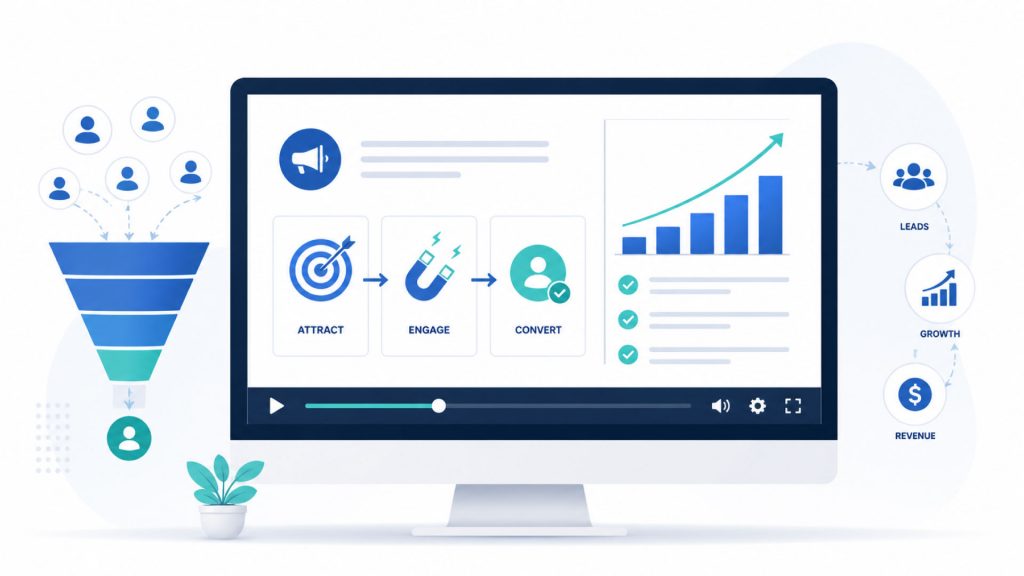
The goal is to make the offer easier to understand so more of the right people take the next step.
This is where video becomes part of your wider lead strategy, rather than a one-off asset that sits on the website and gets forgotten.
2. Turning attention into action
A lot of businesses create content that gets seen but does not convert.
They post videos, clips, blogs and social content, but there is no clear journey behind it.
An animated commercial can help here if it gives the viewer a simple next step.
That could be:
- Take a diagnostic
- Watch a training video
- Register for a webinar
- Download a guide
- Book a discovery call
- View a relevant service page
This is where video becomes part of the system.
For example, a short animated video could be used to introduce your offer and send people to the Lead Strategy Diagnostic.
That is far more useful than a video that simply ends with “get in touch”.
3. Supporting webinar campaigns
Webinars are one of the strongest ways to generate B2B leads because they capture intent.
Someone who registers for a webinar is actively interested in a topic. They are giving you time and attention around a specific problem.
That creates an opportunity.
Animation can support that journey by helping to promote the event, explain the topic or make the follow-up content more engaging.
For example, you might use animation to create:
- A short webinar promo
- A visual breakdown of the problem
- A simple animated section inside the webinar
- A post-event recap video
- Social clips that drive people to the on-demand version
The webinar is the conversion moment.
The video helps get people there.
That is why we treat webinars as part of a wider webinar lead generation process, not just a one-off event.
4. Repurposing podcast and webinar content
This is where video becomes much more efficient.
If you are already recording podcasts or webinars, you do not always need to create brand new video ideas from scratch.
You can take the strongest ideas from those recordings and turn them into animated or motion-led content.
For example:
- A guest insight from a podcast becomes a short visual clip
- A webinar framework becomes an animated explainer
- A recurring customer problem becomes a simple social video
- A key stat becomes a motion graphic
- A complex process becomes a visual breakdown
This helps you get more value from the content you are already creating.
It also means your content is not dependent on one long-form recording doing all the work.
This is a big part of how we approach podcast-led lead generation. The podcast starts the conversation, but the content created from it keeps building visibility after the episode is published.
If you want to go deeper into this, our guide to B2B podcast content repurposing breaks down how one podcast can be turned into multiple useful assets.
5. Building trust before a sales conversation
For higher-value B2B services, people rarely enquire after seeing one piece of content.
They need repeated exposure.
They need to understand your thinking.
They need to see that you understand their problem.
Video helps with this because it builds familiarity quickly.
Animation can support that by making your ideas easier to digest, especially when paired with a clear message and strong follow-up journey.
But again, the important part is the journey.
A video should not sit on its own.
It should connect to:
- A relevant blog
- A service page
- A diagnostic tool
- A webinar
- A podcast episode
- A booking journey
That is how content starts to support pipeline.
2B buyers are increasingly using digital channels to discover, research and make buying decisions before they speak to a supplier, which is why content needs to support the journey before the sales conversation starts.
When animated commercials work well
Animated commercials can work well when the business has a clear message and a clear audience.
They are especially useful when:
- The offer is hard to explain quickly
- The product or service is not visually obvious
- The business needs to simplify a process
- The brand wants a distinctive visual style
- The content needs to work across multiple channels
- The sales team needs better assets for follow-up
The best animated videos are not just creative.
They are useful.
They help the viewer understand something faster than they would through text alone.
That is the real value.
When animation is probably not the right starting point
Animation is not always the first thing you should create.
If your positioning is unclear, animation will not fix it.
If you do not know who you are targeting, animation will not fix it.
If there is no follow-up process, animation will not fix it.
If your website does not clearly explain what you do, animation will not fix it.
This is why we usually start with strategy before production.
Before creating any video, you need to understand:
- Who the content is for
- What problem it is addressing
- Where it will be used
- What action it should drive
- How it connects to the wider sales journey
Without that, you risk creating content that looks good but does very little.
If you are not sure what your business needs first, the Lead Strategy Diagnostic is a useful place to start.
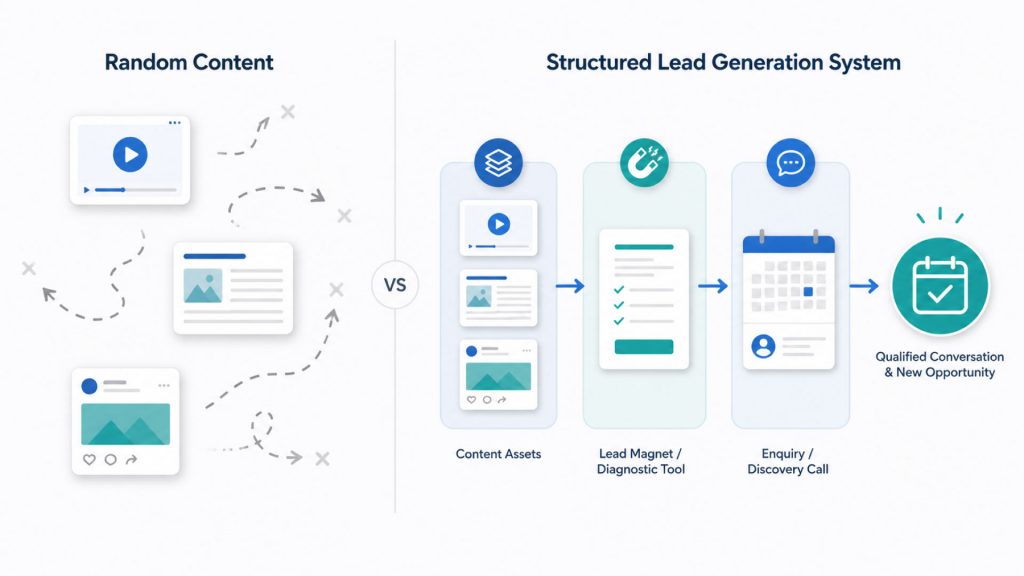
A better way to think about video content
Instead of asking:
“Should we make an animated commercial?”
Ask:
“What content do we need to help our buyers take the next step?”
That might be animation.
It might be a podcast clip.
It might be a webinar.
It might be a talking-head video.
It might be a YouTube explainer.
It might be a written guide with a strong CTA.
The format should follow the strategy.
For example:
- If you need access to decision-makers, a podcast might be the better starting point
- If you need more qualified inbound interest, a webinar might be stronger
- If people do not understand your offer, an explainer video might help
- If you need more visibility, video SEO and search-led content might be the priority
- If people are engaging but not converting, a conversion-focused content system might be the gap
That is why we now look at content as a system rather than a collection of one-off assets.
This also lines up with Google’s guidance around creating helpful, people-first content, rather than content created purely to manipulate search rankings.
How animated content fits into a wider lead generation system
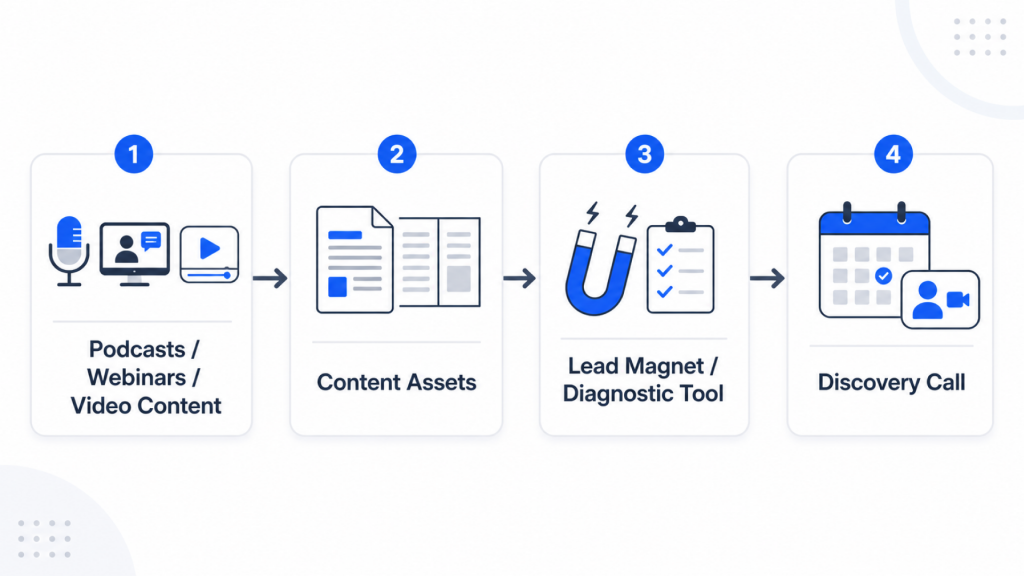
A working content-led lead generation system might look like this:
- Define the audience you want to reach
- Identify the problems they are actively thinking about
- Create long-form content around those problems
- Use video and animation to make key ideas easier to understand
- Repurpose that content across search, LinkedIn, YouTube and email
- Use a diagnostic, webinar or training video to capture intent
- Move the right people into a discovery call
In that setup, animation is not the whole strategy.
It is one useful part of it.
That is a much better way to use video content.
For businesses using podcasts as the starting point, this can also connect into a wider B2B podcast strategy, where long-form conversations are repurposed into clips, blogs, emails and sales assets.
Content Marketing Institute’s 2025 B2B research shows marketers increasing investment across video, thought leadership, webinars and audio content, which supports the idea that these formats work best as part of a joined-up strategy.
Not sure what type of lead generation content you need?
Most businesses do not need to create more content at random.
They need to understand which part of their lead generation system is weakest.
For some, the issue is visibility.
For others, it is trust.
For others, it is access to the right people.
For others, it is conversion.
That is why we built the Lead Strategy Diagnostic.
It helps you work out what kind of lead generation route makes the most sense for your business right now.
You might need podcast-led outreach.
You might need webinars.
You might need better content.
You might need a stronger conversion journey.
The diagnostic gives you a clearer starting point.