
Top 10 2D Animation Examples for Business and B2B Lead Generation
Table of Contents
What are 2D animation examples for business?
If you’re looking for 2D animation examples for business, the best place to start is not the animation style.
It is the job the video needs to do.
A 2D animation can explain an idea. It can simplify a service. It can show a process. It can make a dry topic easier to understand.
That is useful.
But animation on its own will not generate leads.
The real value comes when animation sits inside a bigger system.
At Echo Works, we now focus on helping B2B companies build lead generation systems using podcasts, webinars, video and content.
That means animation can still play a role.
But it needs to support a clear outcome.
It should help the right person take the next step. That might be watching a training video, taking a diagnostic, signing up for a webinar or booking a discovery call.
A nice video is fine.
A useful video is better.
Why should businesses use 2D animation?
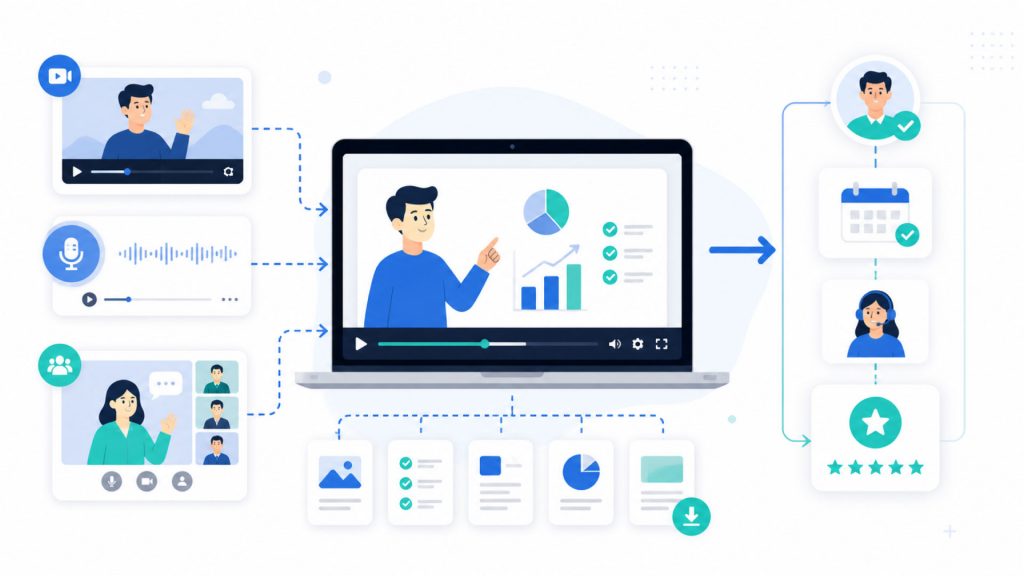
Businesses use 2D animation because it can make hard ideas easier to understand.
That is the simple answer.
If your offer is complex, animation can help explain it.
If your process has several steps, animation can help show the journey.
If your audience does not understand the problem yet, animation can help teach it.
This is especially useful for B2B companies.
Many B2B services are not easy to explain in one sentence. They often involve process, trust, expertise and a clear business case.
That is where animation can help.
But the video still needs a clear role.
Before creating any animated video, ask:
- Who is this for?
- What do they need to understand?
- Where will this video sit?
- What should they do after watching?
- How does this support our wider lead generation system?
If you cannot answer those questions, the video may look good but do very little.
That is the trap.
A video should not just fill space on a website. It should help move someone closer to action.
Google’s own guidance around helpful, people-first content is useful here. Content should be created to help people, not just to tick a search or marketing box.
What are the best 2D animation examples for business?
The best 2D animation examples for business are the ones that make something clearer.
They do not need to be flashy.
They need to be useful.
Below are the main types of 2D animation that can support a B2B lead generation system.
1. Animated explainer videos
Animated explainer videos are one of the most common examples of 2D animation in business.
They are used to explain what a company does, how a service works or why a product matters.
They work well when the offer is not instantly obvious.
For example, an animated explainer could help explain:
- A software platform
- A consultancy process
- A technical service
- A training programme
- A compliance issue
- A customer onboarding journey
- A complex product or service
The goal is simple.
Help the viewer understand the offer faster.
This matters because confused people do not convert.
If someone lands on your website and cannot quickly understand what you do, they are unlikely to enquire.
An explainer video can help fix that.
But only if it sits in the right place.
Good places to use an animated explainer include:
- Your homepage
- A service page
- A landing page
- A sales proposal
- A follow-up email
- A webinar registration page
This is where animated video connects to conversion-focused content.
The video is not just there to look nice.
It helps the buyer understand what you do and why it matters.
2. Motion graphics for key messages
Not every business animation needs to be a full explainer.
Sometimes, a short motion graphic is enough.
Motion graphics work well when you need to highlight one clear idea.
That could be:
- A key statistic
- A common problem
- A simple process
- A customer pain point
- A short framework
- A campaign message
- A product benefit
This type of animation is useful because people can understand it quickly.
It can work well on LinkedIn, YouTube, email, landing pages and paid campaigns.
Motion graphics are also useful when you are repurposing longer content.
For example, you might take one strong idea from a podcast or webinar and turn it into a short animated clip.
That gives you a new content asset without creating a new idea from scratch.
This is where animation can support podcast-led lead generation.
The podcast creates the original conversation.
The motion graphic helps turn that conversation into a short, useful piece of content.
3. Animated social clips
Animated social clips can work well when they focus on one point.
This is where many businesses go wrong.
They try to make one short video do too much.
A good social clip should make one idea easy to understand.
For example:
- “A podcast is not a lead generation tool unless there is a follow-up system.”
- “A webinar works best when it is part of a campaign, not a one-off event.”
- “Video should help people take the next step, not just fill a content calendar.”
Each of those points could become a short animated clip.
The clip grabs attention.
The caption adds context.
The CTA moves people to the next step.
That next step could be:
- A diagnostic tool
- A podcast training video
- A service page
- A webinar
- A blog post
- A discovery call
This is important.
Social content by itself rarely creates pipeline.
It needs somewhere to send people next.
That is the difference between random content and a content system.
4. Animated webinar content
Webinars are strong lead generation tools because they capture intent.
Someone who signs up for a webinar is not just scrolling past content.
They are giving you time and attention around a specific topic.
That is valuable.
2D animation can support webinars in several ways.
You could use animation to:
- Promote the webinar
- Explain the topic before the session
- Break down a framework during the webinar
- Show a customer journey
- Create short clips after the event
- Turn the webinar into evergreen content
This helps you get more value from each webinar.
Too many businesses run a webinar, send one follow-up email and then move on.
That is a waste.
A webinar can create multiple content assets.
It can become blogs, clips, email content, sales follow-up material and social posts.
Animation can make some of those assets easier to understand.
That is why we treat webinars as part of a wider webinar lead generation system.
The webinar creates intent.
The content around it keeps the conversation going.
5. Animated podcast content
A podcast does not have to stay as a long video or audio episode.
Some of the best ideas from a podcast can be turned into animated content.
This works well when a guest explains:
- A common mistake
- A useful framework
- A strong opinion
- A business lesson
- A process
- A market trend
- A simple story
Instead of only posting a talking-head clip, you can turn that idea into an animated asset.
For example:
- A quote-led animation
- A short visual breakdown
- A narrated explainer
- A motion graphic with key points
- A simple animated story based on the guest’s insight
This gives you more ways to use the same conversation.
It also helps the idea reach people who may not watch the full episode.
That is why podcasts work well as a content engine.
A single episode can support video clips, blogs, LinkedIn posts, email content, sales assets and animated explainers.
Wistia’s video marketing statistics are useful here because they show how widely businesses now use video formats such as educational videos, social videos, product videos and webinars as part of their marketing.
For Echo Works, this is the real value of podcasting.
The podcast starts the conversation.
The content created from it keeps building visibility after the episode is published.
In this video, we explain how we run podcasts for clients and how the process supports lead generation, relationship-building and content creation.
6. Animated sales enablement videos
Not every animated video needs to attract new visitors.
Some videos are useful after someone has already shown interest.
This is called sales enablement.
It means creating content that helps your sales process.
2D animation can work well here because it can explain the same idea clearly every time.
For example, you could use animation to explain:
- Your process
- Your pricing model
- What happens after a discovery call
- A common objection
- A technical feature
- The business case for your service
- What the client needs to prepare
This can be sent after a call.
It can sit inside a proposal.
It can be used in email follow-up.
It can help prospects understand the next step.
This type of content may not get thousands of views.
But that does not matter.
If it helps the right person make a decision, it is doing its job.
That is what useful content looks like.
7. Animated educational content
Educational content works well when your buyers need to understand the problem before they are ready to speak to you.
This is common in B2B.
People may not be ready to book a call today.
But they are researching.
They are comparing options.
They are trying to understand what matters.
Animated educational content can help with this.
It can explain:
- Why a problem matters
- What options are available
- What mistakes to avoid
- How a process works
- How to think about a decision
- What good looks like
This type of content builds trust.
It shows your thinking.
It helps buyers feel more confident before they speak to you.
That is why it works best when it is connected to search, YouTube, blogs and email.
It should not sit on its own.
It should support a wider video SEO and content strategy.
Content Marketing Institute’s B2B content marketing research also shows that B2B marketers continue to invest in formats such as video, thought leadership, webinars and audio content. That supports the idea that these formats work best when they are joined together properly.
8. Animated case studies
Case studies are powerful.
But many businesses underuse them.
A written case study can be useful.
An animated case study can make the story easier to understand.
It can show:
- The client’s problem
- The solution
- The process
- The result
- The wider impact
This is useful when the work is hard to film or difficult to explain.
For example, if you sell a service, software or consulting offer, animation can help show value without needing a live-action shoot.
A good animated case study does not need to be long.
It just needs to answer four questions:
- What was the problem?
- What did you do?
- Why did it matter?
- What happened next?
That makes it useful for sales teams, proposals, landing pages and follow-up emails.
Again, the value is not just the video.
The value is how the video supports the buyer journey.
9. Animated product or service walkthroughs
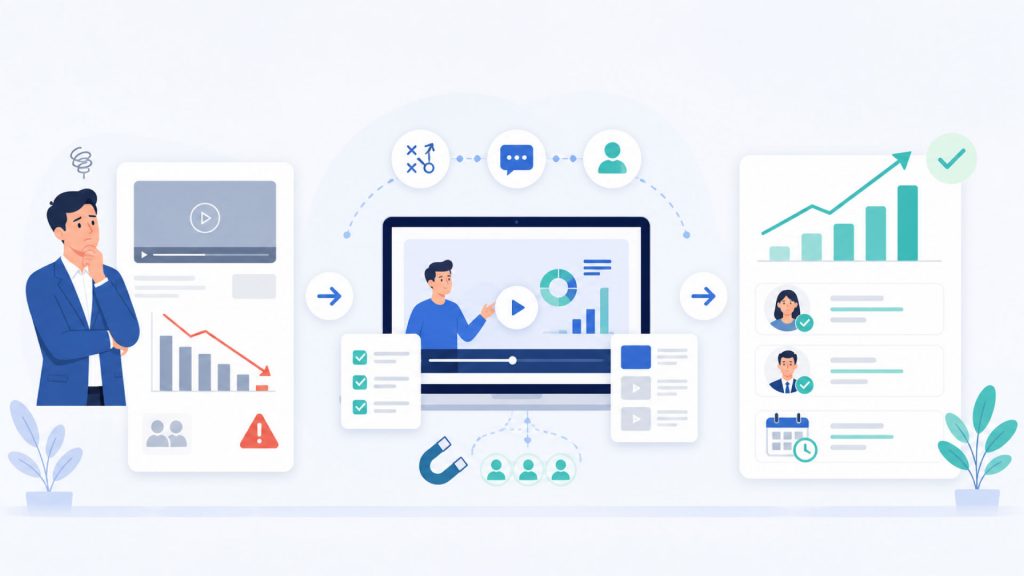
If your product or service has several steps, animation can help make the journey clearer.
This works well for:
- Software platforms
- Professional services
- B2B onboarding
- Training programmes
- Internal systems
- Technical tools
- Multi-stage sales processes
A walkthrough helps people understand what will happen before they commit.
That reduces uncertainty.
And in B2B, uncertainty can slow down decisions.
A good animated walkthrough can explain:
- What the process looks like
- What the customer needs to do
- What your team handles
- How long things take
- What happens after the first call
This can improve the quality of your enquiries.
People arrive with a better understanding of how you work.
That makes the first conversation more useful.
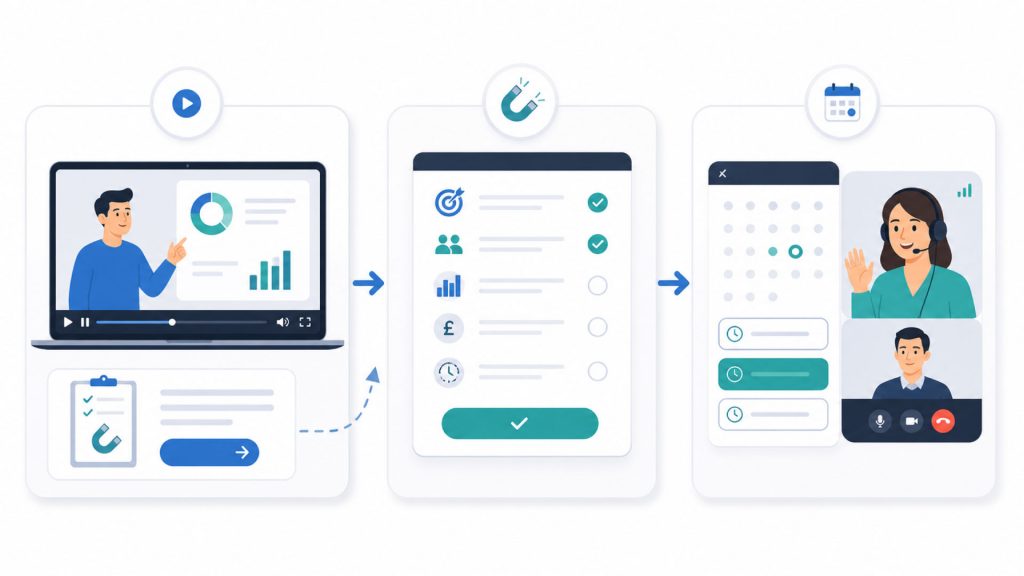
10. Animated lead magnet explainers
Lead magnets work better when people understand why they should use them.
If you have a diagnostic tool, guide, checklist or calculator, animation can help explain the value quickly.
For example, Echo Works has a Lead Strategy Diagnostic that helps businesses work out which type of lead generation route makes most sense for them.
A short animated video could explain:
- Who the diagnostic is for
- What it helps you understand
- What happens after completing it
- Why it is worth taking a few minutes to do
This is a strong use of animation because it is tied directly to conversion.
The video does not just raise awareness.
It helps someone take action.
That is the difference between nice content and useful content.
How do you choose the right type of 2D animation?
The right type of 2D animation depends on the job it needs to do.
Start with the goal.
Not the style.
What does the viewer need to understand?
If your offer is complex, you may need an explainer.
If your process is unclear, you may need a walkthrough.
If your audience needs education, you may need a short teaching video.
Where will the animation be used?
A homepage video is different from a LinkedIn clip.
A webinar asset is different from a sales follow-up video.
A YouTube explainer is different from an email nurture asset.
The placement changes the structure.
What action should the viewer take next?
This is the most important question.
After watching the animation, should someone:
- Take a diagnostic?
- Watch a training video?
- Register for a webinar?
- Read a related guide?
- Book a call?
- Visit a service page?
If there is no next step, the animation is weaker.
How does this fit into the wider system?
A video should not work alone.
It should connect to other content.
For example, it might support:
- A blog post
- A podcast episode
- A webinar campaign
- A landing page
- A sales sequence
- A service page
This is how you build a system instead of a collection of assets.
When is 2D animation not the right starting point?
Sometimes, 2D animation is not the first thing you need.
If you need access to decision-makers, a podcast may be stronger.
A podcast gives you a reason to speak to people you want to build relationships with.
If you need more warm inbound interest, a webinar may be the better starting point.
If people are already engaging but not enquiring, your conversion journey may be the issue.
If people do not know who you are, you may need a stronger content and video SEO strategy.
This is why starting with the format can be risky.
The better starting point is the problem.
What is stopping leads from happening?
- Visibility?
- Trust?
- Access?
- Conversion?
Once you know that, it is easier to choose the right content.
If you are not sure where to start, use the Lead Strategy Diagnostic.
It will help you understand which lead generation route makes most sense for your business.
Where does 2D animation fit into a lead generation system?
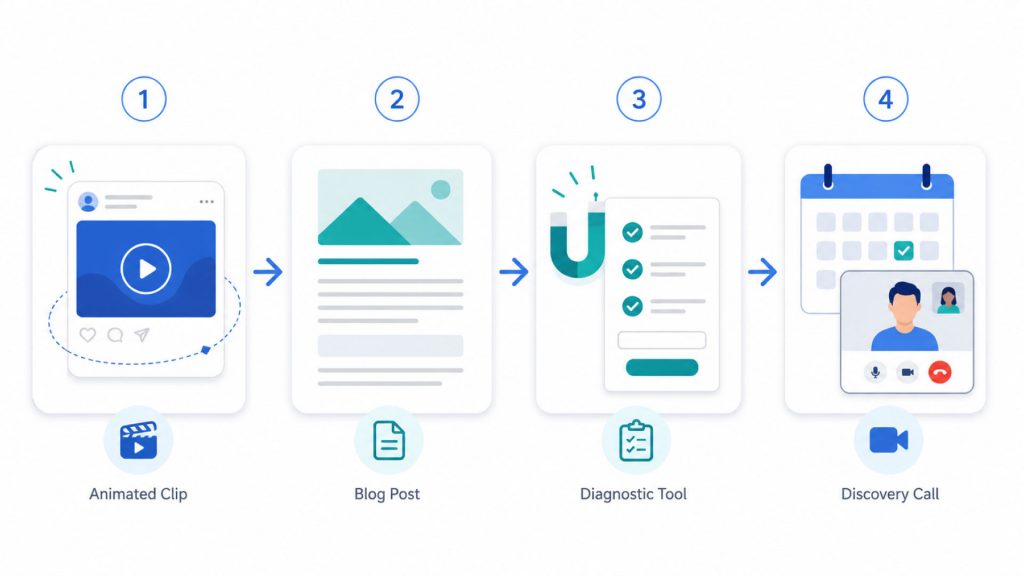
A simple content-led lead generation system might look like this:
- A podcast or webinar creates the original idea.
- The strongest points become clips, blogs and animated assets.
- Those assets are shared across search, YouTube, LinkedIn and email.
- The content sends people to a diagnostic, training video or service page.
- Warm prospects move into a discovery call.
In that system, 2D animation has a clear role.
It helps explain the idea.
It makes the content more useful.
It supports the next step.
This is how animation becomes part of a commercial system.
Not just another creative asset.
For businesses that already have podcasts or webinars, this approach can be especially useful.
You are not constantly starting from scratch.
You are turning your best ideas into content that can work harder across more channels.
Not sure what kind of content you need?
Most businesses do not need more random content.
They need to know which part of their lead generation system is weak.
That is why we built the Lead Strategy Diagnostic.
It helps you understand which route makes most sense for your business.
You might need:
- Better access to decision-makers
- A stronger webinar funnel
- More useful video content
- Better conversion content
- A clearer lead generation strategy
The diagnostic gives you a simple starting point.
What should you do next?
If you came here looking for 2D animation examples for business, the short answer is this:
2D animation can still be useful.
But it should have a clear job.
For B2B companies, that job is usually to explain, educate, build trust or move someone closer to action.
At Echo Works, we help businesses build lead generation systems using podcasts, webinars, video and content.
If you are not sure where to start, take the Lead Strategy Diagnostic.
If you already know the area you want to improve, explore:
- Podcast-led lead generation
- Webinar lead generation
- Video SEO
- Conversion-focused content
- Lead generation strategy
Or book a discovery call and we can look at what you are trying to build.
FAQs
What are 2D animation examples for business?
2D animation examples for business include explainer videos, motion graphics, animated adverts, product walkthroughs, webinar visuals, podcast clips, educational videos, case studies and lead magnet explainers.
Is 2D animation useful for B2B marketing?
Yes. 2D animation can be useful for B2B marketing when it helps explain a complex idea, simplify a service or move a buyer closer to action.
Can 2D animation generate leads?
Yes, but usually not on its own. 2D animation is more likely to generate leads when it connects to a clear CTA, landing page, diagnostic tool, webinar or follow-up journey.
What is the best type of 2D animation for business?
The best type depends on the goal. Explainer videos work well for complex offers. Motion graphics work well for short ideas. Walkthroughs work well for processes. Animated case studies work well for proof.
Should I start with animation, a podcast or a webinar?
It depends on the problem. If you need access to decision-makers, start with a podcast. If you need warmer inbound leads, start with a webinar. If people do not understand your offer, animation or video may help.
How long should a 2D animated business video be?
Most business animations should be short and focused. A social clip might be 15 to 45 seconds. An explainer might be 60 to 120 seconds. The length should match the goal and where the video will be used.
Where should I use 2D animation on my website?
You can use 2D animation on your homepage, service pages, landing pages, blog posts, webinar pages and lead magnet pages. It should support the user journey and help people take the next step.