
How to Reach Decision Makers with Podcasts: The Secret B2B Strategy Everyone Overlooks
Why is it so hard to reach decision makers?
Reaching senior decision makers is harder than it used to be.
Most founders, CEOs, MDs and CMOs are busy.
They get cold emails every day.
They receive LinkedIn messages from people they do not know.
They are invited to “quick chats” all the time.
Most of it gets ignored.
That is not because decision makers never want to speak to new people.
It is because most outreach gives them no real reason to care.
A standard cold message usually asks for their time before offering anything useful.
That is why podcasts can work differently.
If you want to reach decision makers with podcasts, the value is not just in the content.
The value is in the reason to start the conversation.
A podcast invite feels different to a sales pitch.
You are not asking someone to sit through a demo.
You are offering them a platform.
You are giving them a chance to share their ideas.
You are creating content they can use.
That changes the tone of the conversation from the start.
At Echo Works, this is one of the main reasons we use podcast-led lead generation for B2B companies.
The podcast gives you access.
The conversation builds trust.
The content keeps the relationship warm.
The follow-up turns it into pipeline.
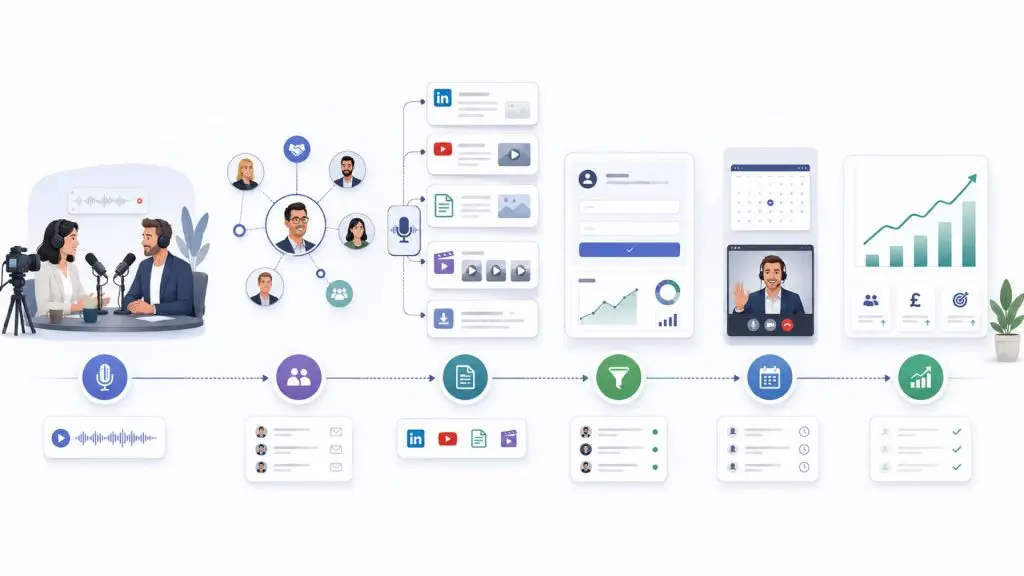
Table of Contents
How can podcasts help you reach decision-makers?
Podcasts help you reach decision makers because they give you a stronger reason to get in touch.
Instead of saying:
“Can we book a call so I can tell you about us?”
You are saying:
“We’d like to invite you onto a podcast to share your experience and perspective with our audience.”
That is a much better opener.
It gives the other person something.
It gives them visibility.
It gives them content.
It gives them a reason to talk about their expertise.
For B2B companies, this matters because access is often the hardest part of lead generation.
You may have a strong offer.
You may have a clear service.
You may know exactly who you want to reach.
But if the right people do not reply, the sales process never starts.
A podcast can help open that door.
Not by forcing a sales conversation.
By creating a useful first conversation.
That is the key difference.
Is this just cold outreach with a microphone?
No.
At least, it should not be.
Bad podcast outreach can feel just as lazy as bad sales outreach.
If you send a generic podcast invite to random people, it will not work well.
A podcast only helps you reach decision-makers when the guest strategy is clear.
That means knowing:
- Who you want to speak to
- Why they are relevant
- What topic would interest them
- Why your audience would care
- How the episode fits your wider business goal
- What happens after the recording
This is where B2B podcast guest strategy matters.
The guest should not be chosen just because they are available.
They should fit the audience, the theme and the commercial reason behind the podcast.
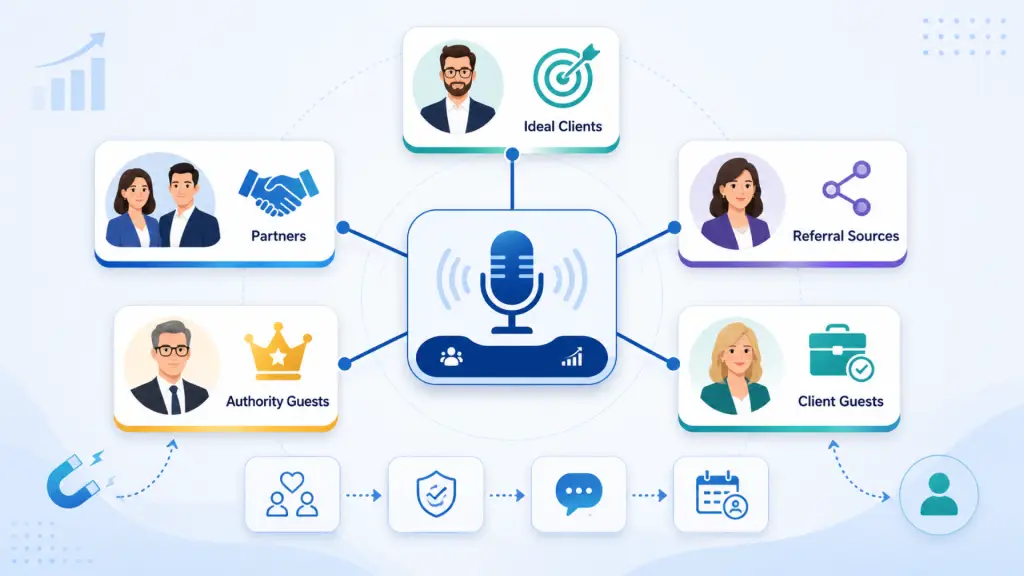
That does not mean every guest needs to be a direct sales prospect.
Some guests may be ideal clients.
Some may be partners.
Some may be referral sources.
Some may be industry voices that improve the authority of the show.
The point is that every guest should have a reason to be there.
Why does a podcast invite work better than a cold sales message?
A podcast invite often works better because it changes the value exchange.
A cold sales message usually asks for something.
A podcast invite offers something.
That is a big difference.
For the guest, a podcast can offer:
- Visibility
- Credibility
- Useful content
- A chance to share their thinking
- A reason to connect with a relevant audience
- A polished piece of content they can use later
For your business, the podcast creates:
- A warm conversation
- A useful relationship
- Long-form content
- Short-form clips
- Follow-up reasons
- A better understanding of the guest’s world
- A route into future opportunities
This is why podcasts can be so useful for B2B relationship-building.
They move the first conversation away from selling and towards value.
That is not a gimmick.
It is a better way to start.
Google’s guidance on helpful, people-first content is relevant here. The best content is built around helping real people, not just creating content for the sake of it.
Want to see how we run podcasts for clients?
Who should you invite onto a B2B podcast?
If you want to reach decision makers with podcasts, your guest list needs to be planned carefully.
Do not start with famous people.
Start with relevance.
Good B2B podcast guests usually fall into five groups.
1. Ideal client guests
These are people who fit your ideal customer profile.
They might be founders, CEOs, MDs, CMOs, operations leaders or senior decision-makers in the types of companies you want to work with.
The aim is not to pitch them during the episode.
The aim is to start a useful relationship.
A good interview gives you time to understand their world.
It also gives them time to understand how you think.
That is a much better foundation than a cold sales call.
2. Partner guests
These are people who work with the same audience but do not directly compete with you.
For example:
- Consultants
- Agencies
- Coaches
- Technology partners
- Industry experts
- Professional service providers
Partner guests can become referral sources.
They can also help you reach wider networks.
3. Referral guests
These are people who may not buy from you, but they know people who could.
They are valuable because they sit close to your market.
A podcast gives you a reason to build a relationship with them.
4. Authority guests
These guests help raise the credibility of the show.
They might be known voices in your industry.
They might have strong experience or a useful point of view.
They may not become leads, but they make the podcast more valuable.
5. Client guests
Existing clients can make excellent guests.
They can share real stories, lessons and outcomes.
This can support trust, proof and sales enablement.
A client episode can often become more than a podcast.
It can become a case study, short clips, sales content and a useful resource for future prospects.
How do you choose the right podcast guests?
Start with your business goal.
If the podcast is designed to support lead generation, your guest list should connect to your ideal customer profile.
Ask:
- Who do we want to reach?
- Who do we want to build relationships with?
- Who influences our buyers?
- Who has a story our audience would find useful?
- Who would be valuable to keep in touch with?
- Who could become a future client, partner or referrer?
Then score potential guests by fit.
You can use simple criteria:
- Relevance to your audience
- Seniority
- Sector fit
- Commercial fit
- Quality of insight
- Network value
- Likelihood of sharing the episode
- Relationship potential
This helps you avoid random guest selection.
A podcast guest is not just someone to fill an episode.
They are part of the wider B2B podcast strategy.
What should your podcast outreach message say?
Your outreach message should be short, specific and human.
Do not make it sound like a mass email.
Do not over-explain the podcast.
Do not pretend you are doing them a huge favour.
Be clear about why you are inviting them.
A good podcast invite should include:
- Who you are
- Why you are reaching out
- Why they are relevant
- What the podcast is about
- What the conversation would cover
- That there is no cost to be a guest
- A simple next step
For example:
Hi [Name], I’m working on a B2B podcast that speaks with leaders in [sector/topic] about [theme]. I thought your experience at [company] would make for a really useful conversation, especially around [specific topic].
It is not paid or sponsored. We would record remotely, and you would get clips and assets to use afterwards.
Would you be open to me sending a little more detail?
That is much stronger than:
Quick question. Do you want to be on our podcast?
The best outreach feels personal without becoming an essay.
The goal is not to close everything in one message.
The goal is to start a conversation.
Should you mention sales in the podcast invite?
Usually, no.
The invite should focus on the podcast and the value of the conversation.
That does not mean hiding your business.
It means leading with the right thing.
If you pitch too soon, you damage the trust.
The podcast should create the relationship first.
Then, if there is a relevant reason to continue the conversation later, that can happen naturally.
This is where many businesses get it wrong.
They use the podcast as a disguised sales call.
That feels awkward.
A better approach is:
- Invite the right person.
- Host a genuinely useful conversation.
- Create strong content from the episode.
- Share useful assets with the guest.
- Stay in touch.
- Look for natural commercial opportunities later.
That is how relationship-led lead generation works.
It is slower than a hard pitch, but it often creates better conversations.
What happens before the podcast recording?
The work starts before the recording.
A good pre-recording process helps the guest feel comfortable and makes the episode better.
It also helps you build a relationship before the microphone is on.
Your pre-recording process might include:
- A short pre-call
- Guest briefing notes
- Suggested topics
- Recording instructions
- Calendar invite
- Tech check
- Questions or themes in advance
- A clear explanation of what happens after recording
The pre-call is especially useful.
It gives you a chance to:
- Understand the guest’s background
- Find the strongest topics
- Build rapport
- Spot useful commercial context
- Make the main recording stronger
This is not just production admin.
It is part of the relationship.
If your goal is to reach decision-makers with podcasts, the experience needs to feel smooth and professional from the first touchpoint.
Our B2B podcast production workflow guide goes deeper into the full process.
What should happen during the podcast episode?
The episode should not feel like a sales pitch.
It should feel like a useful conversation.
The host’s job is to make the guest look good and bring out useful insight.
Good questions usually focus on:
- The guest’s experience
- Lessons they have learned
- Problems they see in the market
- Mistakes businesses make
- How they think about growth
- What buyers need to understand
- Where the industry is heading
The best B2B podcast episodes are not fluffy.
They are practical.
They give the listener something useful.
They also give the guest a good reason to share the episode afterwards.
That matters because guest sharing can expand your reach.
But it only happens if the episode makes them look credible.
What should happen after the podcast recording?
This is where the real lead generation work often starts.
Too many businesses record the episode, publish it and stop.
That is a waste.
After the recording, you should have a clear follow-up process.
This might include:
- Thank-you email
- Confirmation of publish date
- Episode link
- Short video clips
- Suggested LinkedIn copy
- Quote graphics
- Blog link
- YouTube link
- Audio link
- Invitation to stay in touch
- Relevant follow-up conversation if appropriate
The guest should not have to work hard to share the episode.
Make it easy.
Give them assets.
Give them copy.
Give them a clear reason to post.
This helps the episode reach their network.
It also gives you a natural reason to keep the relationship warm.
That is where podcasting starts to support pipeline.
How do podcasts turn guest relationships into pipeline?
Podcasts turn guest relationships into pipeline by creating several useful touchpoints.
You are not relying on one message.
You are building a relationship over time.
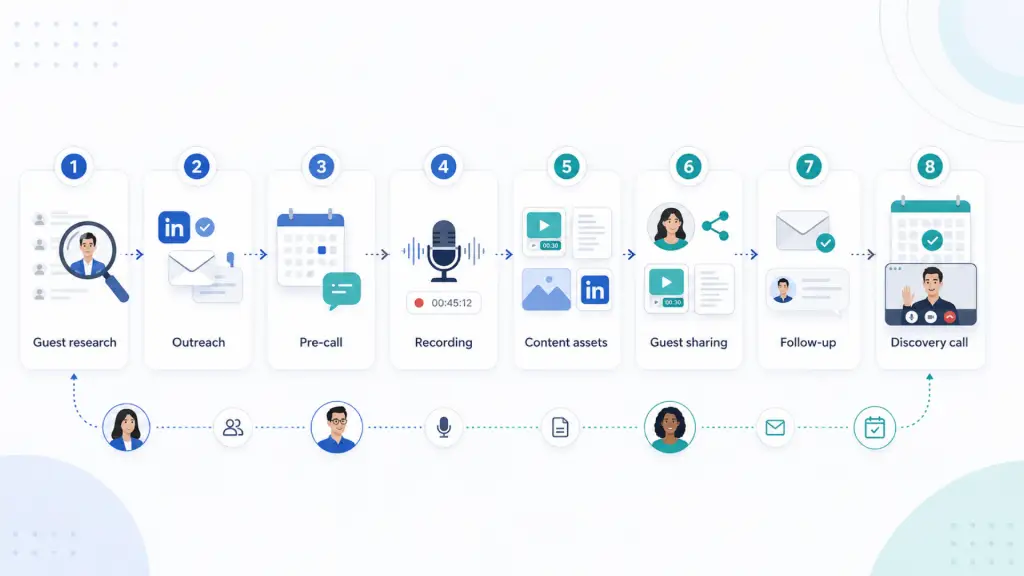
A typical journey might look like this:
- You identify a decision-maker who fits your audience.
- You invite them onto the podcast.
- You have a pre-call.
- You record the episode.
- You publish the episode.
- You send them content assets.
- They share the content with their network.
- You continue the relationship.
- A relevant business conversation opens later.
This does not always happen quickly.
And not every guest becomes a lead.
That is fine.
The value is in building a stronger network of relevant people.
Some may become clients.
Some may become partners.
Some may refer you.
Some may introduce you to others.
Some may simply help improve your authority.
That is why podcast-led lead generation should not be judged only by direct enquiries.
It should also be judged by access, relationships, content and influence.
Our guide to B2B podcast lead generation explains this in more detail.
How does podcast content support decision-maker outreach?
The podcast episode is only one part of the value.
The content created from it can work much harder.
One guest conversation can become:
- Full YouTube episode
- Audio episode
- Short clips
- LinkedIn posts
- Blog article
- Newsletter content
- Quote graphics
- Sales follow-up assets
- Guest sharing pack
- Email nurture content
This is where B2B podcast content repurposing becomes important.
The content gives you reasons to keep showing up.
It also gives your guest content they can use.
That helps the relationship feel more balanced.
You are not just taking their time.
You are creating value from the conversation.
Wistia’s video marketing statistics are useful here, because they show how important video has become across education, social media, product content and webinars.
For B2B companies, this matters because podcast video can support LinkedIn, YouTube, email and sales follow-up.
The episode creates the source material.
The content system spreads the idea.
How do you use LinkedIn after the episode?
LinkedIn is usually one of the most useful platforms for B2B podcast promotion.
That is because your guests, buyers and partners are often already there.
After each episode, create a simple LinkedIn plan.
This might include:
- Announcement post
- Short video clip
- Quote post
- Guest tag
- Founder reflection post
- Key takeaway post
- Comment follow-up
- Newsletter mention
- Direct follow-up to relevant contacts
Do not just post the episode link and hope.
Give people a reason to care.
Pull out the strongest idea.
Make the post useful on its own.
Then link to the full episode or related blog.
This is also where your guest assets matter.
If you want the guest to share the episode, make it easy.
Send them:
- Clips
- Suggested copy
- Images
- Links
- Publication date
- A short thank-you note
Guest promotion should be planned into the workflow.
Not bolted on later.
How do you use podcast content in sales follow-up?
Podcast content can be very useful in sales follow-up.
Instead of sending a generic “just checking in” email, you can send something genuinely relevant.
For example:
I thought this episode might be useful based on what we discussed. We covered how B2B companies are using podcasts to reach decision-makers and create warmer conversations.
That is better than chasing.
It gives value.
It also shows that you understand the problem.
Podcast clips and blog posts can support:
- Post-call follow-up
- Proposal follow-up
- Long sales cycles
- Account nurturing
- Re-engaging old leads
- Partner conversations
- Referral conversations
This is where podcasts become sales enablement content.
The episode is not just for public promotion.
It can help your sales process too.
How do you measure whether podcasts are reaching the right people?
You need to look beyond downloads.
For this type of podcast, the key question is not:
How many people listened?
It is:
Did this help us reach and engage the right people?
Useful metrics include:
- Guest acceptance rate
- Guest seniority
- Guest fit
- Pre-calls booked
- Episodes recorded
- Guest shares
- LinkedIn engagement from target accounts
- Website visits from podcast content
- Lead Strategy Diagnostic completions
- Discovery calls booked
- Follow-up conversations
- Referrals
- Pipeline influenced
- New relationships created
This is where B2B podcast analytics matters.
Downloads are one part of the picture.
They are not the whole story.
For B2B podcasting, a small number of highly relevant people can be more valuable than a large number of passive listeners.
What mistakes should you avoid?
If you want to reach decision-makers with podcasts, avoid these mistakes.
Mistake 1: Inviting random guests
Random guests create random results.
Start with your ideal customer profile and business goal.
Mistake 2: Making the invite all about you
The guest needs to understand why the conversation is worth their time.
Lead with relevance and value.
Mistake 3: Turning the podcast into a sales pitch
This damages trust.
The podcast should create a useful conversation first.
Mistake 4: Having no follow-up plan
If you do not follow up, you waste the relationship.
Plan the follow-up before the episode goes live.
Mistake 5: Not giving guests assets
Make it easy for guests to share.
Send clips, copy and links.
Mistake 6: Measuring only downloads
Downloads matter, but they are not the full value.
Measure relationships, content, conversations and pipeline too.
Mistake 7: Not linking the podcast to your wider strategy
Your podcast should connect to your service pages, diagnostic, sales follow-up and wider B2B podcast strategy.
Otherwise, it becomes another isolated marketing activity.
Not sure where podcasting fits into your lead generation strategy?
How can Echo Works help you reach decision-makers with podcasts?
Echo Works helps B2B companies use podcasts as part of a lead generation system.
We focus on the strategy around the podcast, not just the recording.
That can include:
- Podcast strategy
- Ideal guest profiling
- Guest outreach
- Guest briefing
- Recording support
- Editing
- YouTube optimisation
- Audio publishing
- Social clips
- Guest asset packs
- Blog content
- Reporting
- Follow-up journeys
The aim is simple.
Use the podcast to start better conversations with the right people.
Then turn those conversations into useful content, stronger relationships and better pipeline.
If you want to see how we run podcasts for clients, add your podcast training video below.
Want to see how we run podcasts for clients?
What should you do next?
If you want to reach decision-makers with podcasts, start with the guest strategy.
Do not start with the microphone.
Do not start with the podcast name.
Do not start with the artwork.
Start with this question:
Who do we want this podcast to help us reach?
Then ask:
What kind of conversation would be valuable for them and useful for our audience?
That is where the strategy begins.
If you want to explore this properly, there are three sensible next steps.
1. Read the wider B2B podcast strategy guide
Start with the complete guide to B2B podcasting if you want the full strategy.
2. Read the B2B podcast lead generation guide
If pipeline is the goal, read the full guide to B2B podcast lead generation.
3. Take the Lead Strategy Diagnostic
Use the Lead Strategy Diagnostic to work out whether podcast-led outreach is the right route for your business.
Or book a discovery call and we can look at what this could look like for you.
Or book a discovery call, and we can look at what this could look like for your business.
FAQs
Can you really reach decision-makers with podcasts?
Yes. Podcasts can help you reach decision-makers because they give you a better reason to start a conversation. Instead of pitching, you invite them to share their expertise.
Why do podcasts work better than cold outreach?
Podcasts often work better because they offer value first. The guest gets visibility, content and a platform. That makes the first conversation feel less like a sales pitch.
Who should I invite onto a B2B podcast?
Good guests include ideal future clients, partners, referrers, industry experts, existing clients and people your buyers already trust.
Should podcast guests be sales prospects?
They can be, but they should not be treated like leads during the episode. The podcast should create a useful relationship first. Commercial opportunities can come later if there is a genuine fit.
How do podcasts generate B2B leads?
Podcasts generate B2B leads by creating access, building trust, producing content, supporting follow-up and moving the right people towards a clear next step.
What should happen after a podcast guest appears?
You should thank the guest, send the episode, share clips and assets, provide suggested copy, keep in touch and look for natural follow-up opportunities.
How do you measure podcast-led outreach?
Measure guest acceptance rate, guest quality, pre-calls, guest shares, LinkedIn engagement, diagnostic completions, discovery calls, follow-up conversations and pipeline influence.
Do decision-makers share podcast episodes?
Some do, especially if the episode makes them look credible and gives them useful assets. Make it easy by sending clips, images, links and suggested LinkedIn copy.
Is podcast-led outreach suitable for every business?
No. It works best for B2B companies that sell high-value services, rely on trust and need to build relationships with senior people.
What is the first step to reach decision-makers with podcasts?
Start by defining who you want to reach. Then build a guest list around your ideal clients, partners, referrers and trusted voices in your market.